The empire that did not fall
In 476, Rome was left without an emperor. Fifteen hundred kilometres away, in Constantinople, the other half of the empire stayed on its feet, and would last another thousand years. This is the story of its first two centuries: an emperor who wanted to win everything back, a plague, a riot in a racetrack and a fight to the death with the other great empire of its age, the Persia of the Sasanians.

When we talk about the fall of Rome we usually think of the West: the Visigoths in Rome, Attila, Odoacer sending back the imperial regalia. But to someone living in Alexandria, Antioch or Constantinople, the Roman Empire had not fallen at all. It went on collecting taxes, making laws, building churches and fighting wars. Its subjects called themselves Romans, even though they spoke Greek. Historians would later call this empire Byzantine, after Byzantium, the old name of its capital. Its people never used the word.
Over these two centuries the Eastern Empire changed from within: it became more Greek, more Christian and more eastern, and it faced a neighbour as powerful as itself.
The other Rome
When Theodosius died in 395, his sons divided the empire. Arcadius received the East, and with it the richest and most populous part of the Roman world: the granaries of Egypt, the trading cities of Syria, the provinces of Anatolia and the Balkans. While the Germanic peoples turned towards the West, the East enjoyed a relative peace and made good use of it.
Two empires
Theodosius's division was final. The East had its own emperor, its own senate and its own capital: Constantinople, the new Rome that Constantine had founded on the Bosphorus.
An impregnable city
Under Theodosius II the capital was surrounded on the landward side by a triple line of walls. They withstood sieges by Huns, Avars, Persians, Arabs and Bulgars for a thousand years, until the Ottoman cannons of 1453.
Romans who speak Greek
Theodosius II published the Theodosian Code, a collection of imperial laws since Constantine. Latin remained the language of the army and the law; Greek was the language of the street, of culture and of the Church. Alexandria and Antioch were huge cities, far larger than anything in the West.
A single emperor
When Odoacer deposed the last emperor of the West, he sent the imperial regalia to Zeno in Constantinople. In theory the empire was one again. In practice the West already belonged to the Germanic kingdoms.
Anastasius's treasure
Emperor Anastasius, a careful administrator, strengthened the capital's defences and reformed the finances. According to Procopius, he left some 320,000 pounds of gold when he died. That money would pay for everything that came next.
Who made an emperor? There were no fixed rules of succession. A candidate had to be acclaimed by the army, the senate and the people of the capital, and from Leo I in 457 he was also crowned by the patriarch of Constantinople: the power of the came from God. In practice, generals and empresses often held the reins. Ariadne, daughter of Leo I, passed the throne to both her husbands, Zeno and Anastasius.
Religion was politics. The great dispute of the century was over the nature of Christ: the , strong in Egypt and Syria, held that he had a single, divine nature; the Council of Chalcedon (451), that he had two. Every imperial attempt to reconcile the two sides upset someone, often the pope in Rome.
Six kilometres of stone
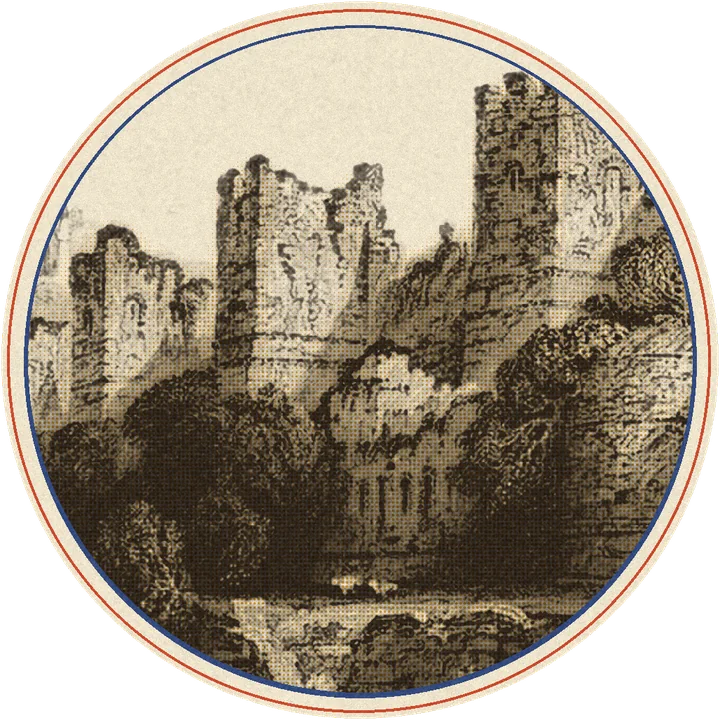
The walls of Theodosius II closed off the peninsula from sea to sea: a moat that could be flooded, an outer wall and an inner wall eleven metres high with 96 towers. No army broke through them by land until 1453, when Ottoman cannons opened a breach. As long as they held, the empire could lose everything and start again.
The emperors of the East, 395–641
Justinian reigned for 38 years; Phocas, who reached the throne by murdering his predecessor, for eight. There was no rule of succession: there were acclamations, marriages and coups.
Justinian
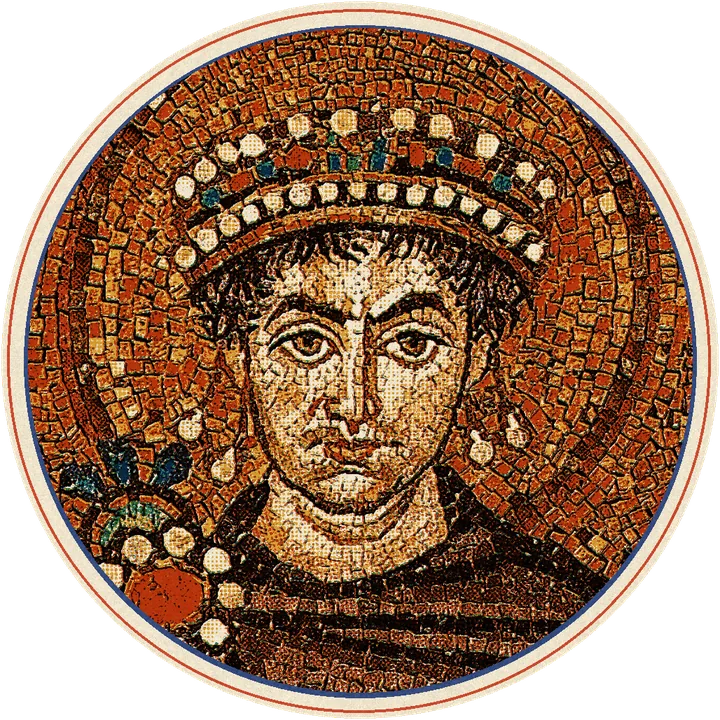
In 518 the throne went to Justin, a soldier of peasant stock from the Balkans who could barely write. His nephew Justinian, educated in Constantinople, governed first in his shadow and then, from 527, on his own. He had one fixed idea: the renovatio imperii, restoring the empire to the size it had had in the days of the Caesars.
An emperor with a plan
Justinian inherited a rich empire, but a surrounded one: the Persians on the Euphrates, Slavs and Bulgars on the Danube, and in the West the kingdoms of the Vandals, Ostrogoths and Visigoths on what had once been Rome.
The Nika riot
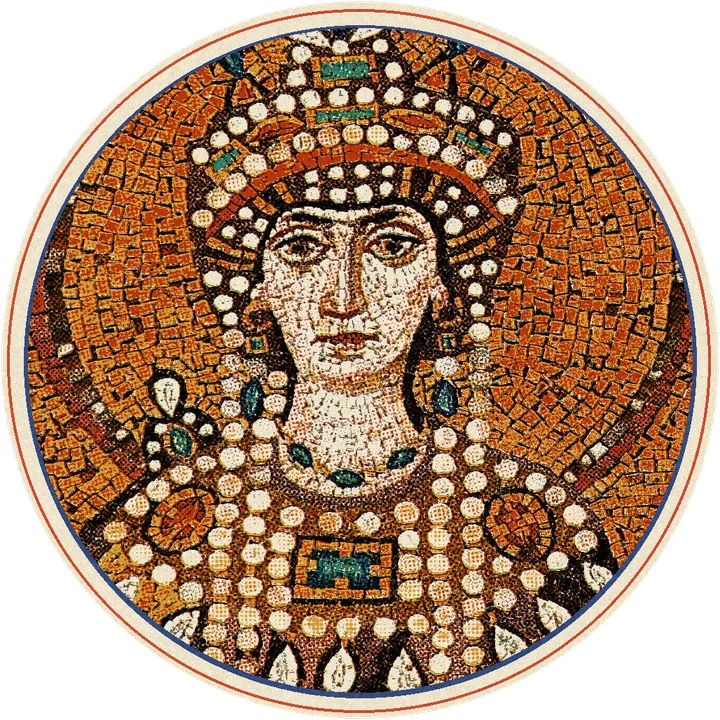
The racetrack factions, the , joined forces against taxation to the cry of Nika!, "conquer!". For six days half the city burned. Justinian prepared to flee; Theodora stopped him. Belisarius trapped the rebels in the Hippodrome: according to Procopius, thirty thousand died.
Africa
The general Belisarius landed in Africa with a small army and within a few months destroyed Gelimer's Vandal kingdom. Carthage was Roman again, a century after it had been lost.
Italy, twenty years of war
Belisarius took Sicily, entered Naples through an aqueduct and reached Rome. But the Ostrogoths held out, above all under King Totila, and the war dragged on for almost twenty years. It was finally won by the eunuch Narses. Italy was left in ruins.
As far as Hispania
Taking advantage of a Visigothic civil war, Athanagild against King Agila, a fleet under Liberius landed in the south-east of the peninsula. For seventy years Cartagena and Málaga formed the Byzantine province of .
The Mediterranean, almost Roman
When Justinian died, the empire once again surrounded much of the Mediterranean. It would never be so large again. Nor so poor.
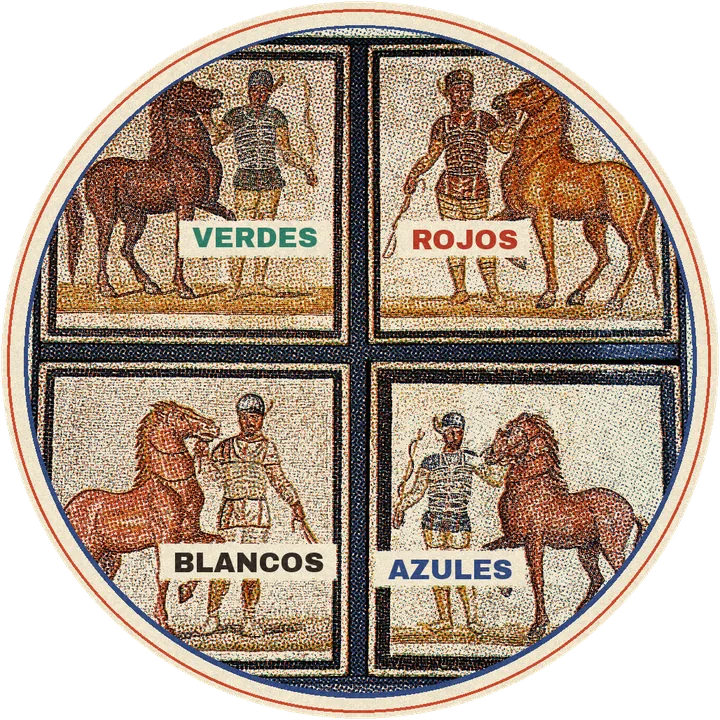
The heart of the city
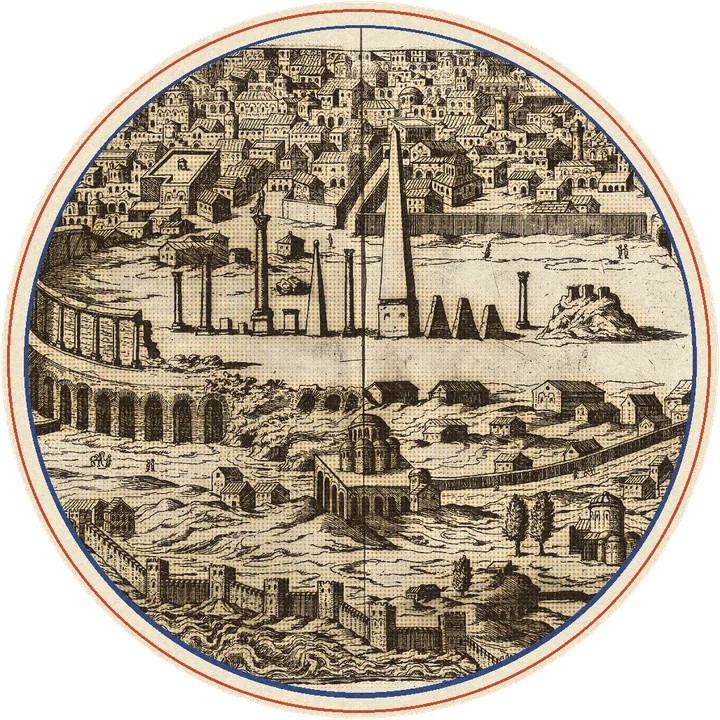
The Hippodrome held some hundred thousand people, and the emperor's box connected directly to the palace. It was the only place where the people could see their ruler and shout at him. The chariot races pitted four teams inherited from Rome against each other, each with its own colour: Whites, Reds, Blues and Greens. By Justinian's time only the last two mattered, having absorbed the others.
The factions were far more than fans. They organised festivals, helped guard the walls, had their own neighbourhoods and their favourites at court, and sometimes their own armed gangs. Usually they hated each other; in 532, for once, they joined forces.
"Royalty is a good burial shroud."Theodora, during the Nika riot (532), according to Procopius of Caesarea
Popular tradition remembers the line as "the purple makes a fine shroud": purple was the colour reserved for the emperor. What Theodora meant was that she would rather die an empress than live in exile. Justinian stayed, and the riot was crushed. What came next was his most lasting work.
The Corpus Iuris Civilis
Justinian commissioned the jurist Tribonian to bring order to a thousand years of Roman law. Within a few years four works appeared which together are known as the . When the jurists of Bologna rediscovered it in the 12th century, it became the basis of the law of half of Europe. It is still studied in law schools today.
Code · 529
- The laws of the emperors since Hadrian. Revised in 534.
Digest · 533
- The opinions of the great Roman jurists, in 50 books.
Institutes · 533
- A textbook for law students.
Novels
- Justinian's new laws, many of them already in Greek.
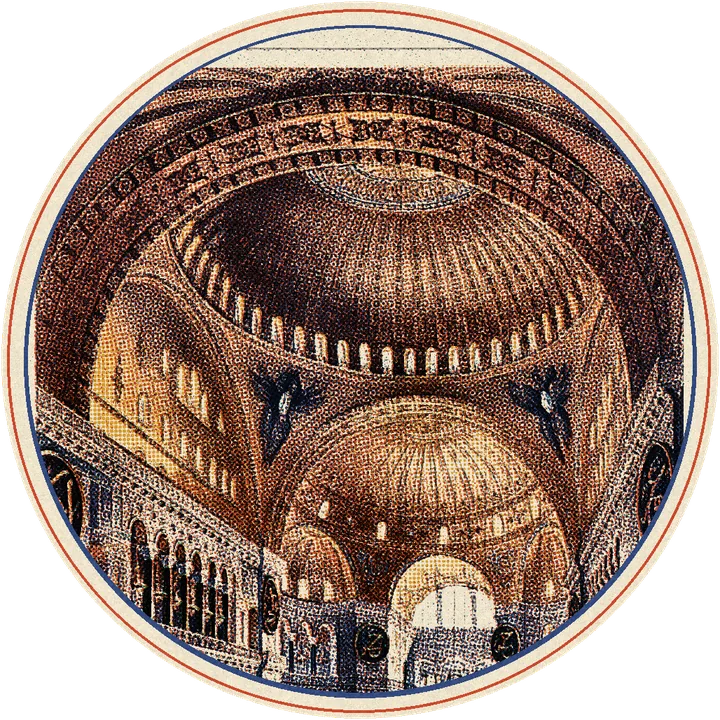
A dome hanging from heaven
On the ashes of the riot, Justinian raised the great church of Hagia Sophia. It was designed by two mathematicians, Anthemius of Tralles and Isidore of Miletus, and finished in barely five years. Its dome, resting on pendentives and ringed with windows, seems to float on light. Procopius wrote that it did not seem to rest on stone at all, but to hang from heaven on a golden chain.
But glory came at a price. The wars emptied Anastasius's treasury, and taxes crushed the provinces. In 542 plague reached Constantinople from Egypt, the first great known pandemic of the disease. Procopius describes thousands of deaths a day. The figures are debated, but the demographic and economic blow was enormous, and the epidemic kept returning for two centuries.
An exhausted empire
Justinian left behind an enormous and exhausted empire. His successors had neither the money nor the soldiers to defend everything at once, and the frontiers began to give way at both ends.
The Lombards
Three years after Justinian's death, the Lombards crossed the Alps from Pannonia and took much of Italy, with their capital at Pavia. Byzantium kept Ravenna, Rome, the south and Sicily.
Avars and Slavs
A people from the steppes, the Avars, settled on the Danube, bringing Slavic tribes with them. Sirmium fell in 582, and the Slavs settled across much of the Balkans and Greece.
The exarchates
Emperor Maurice created the of Ravenna and Carthage: provinces where a single general held both civil and military power. It was the seed of the , Byzantium's military organisation for centuries.
A murder and a pretext
The Danube army mutinied, and an officer named Phocas murdered Maurice and his sons. The king of Persia, Khosrow II, owed his throne to Maurice, and declared himself his avenger. The last and most terrible war between the two empires was about to begin.
The king of kings
Across the Euphrates lay the only empire that Rome always treated as an equal: Persia. Its rulers called themselves , and their capital, Ctesiphon, on the Tigris, was one of the largest cities in the world.
The Sasanians
Ardashir, a lord from the region of Fars, defeated the last Parthian king and founded a new dynasty, the Sasanians. They ruled an urban, well-run empire stretching from Mesopotamia to Central Asia.
A disputed frontier
For four centuries Romans and Persians fought over Armenia and Mesopotamia, with fortresses on both sides of the border, such as Dara. They alternated between wars and treaties, and paid each other tributes in gold.
Khosrow I sacks Antioch
Khosrow I (531–579), Justinian's contemporary, was the great Sasanian king: he reformed taxation according to the fertility of the land and, according to tradition, had Plato and Aristotle translated. In 540 he sacked Antioch and deported its inhabitants to Persia.
A peace paid for in gold
After years of war, the so-called Fifty Years' Peace obliged Byzantium to pay Persia thirty thousand gold coins a year. It did not last even ten.
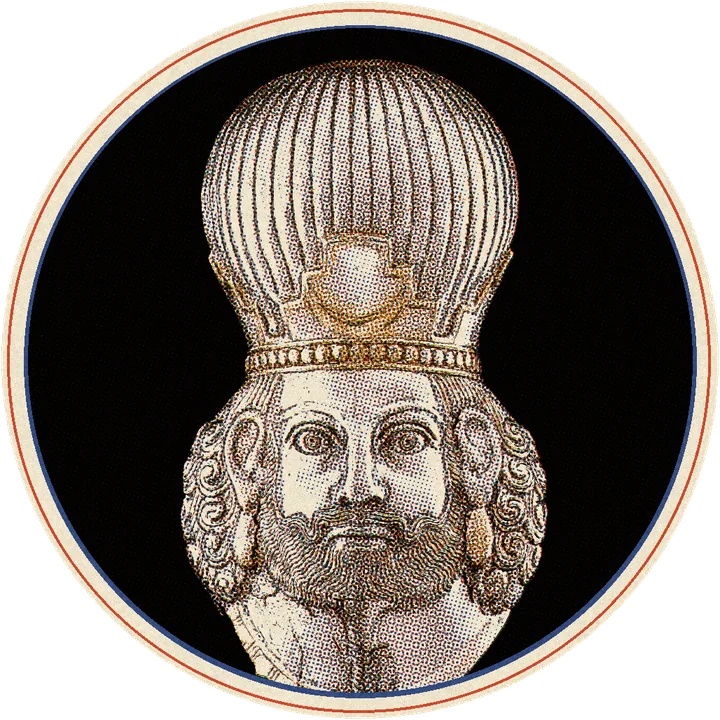
Byzantium against Persia
They hated each other and they were alike: two sacred monarchies, two enormous bureaucracies, two state churches. And a frontier that neither could ever move for good.
Capital
- Byzantium Constantinople
- Persia Ctesiphon
Ruler
- Byzantium the basileus, chosen by God
- Persia the king of kings
State religion
- Byzantium Christianity
- Persia
Currency
- Byzantium the gold solidus
- Persia the silver drachm
Languages
- Byzantium Greek, Latin, Syriac, Coptic
- Persia Middle Persian, Aramaic
Minorities
- Byzantium Monophysites, Jews
- Persia Nestorian Christians, Jews, Manichaeans
Kings in rock and silver
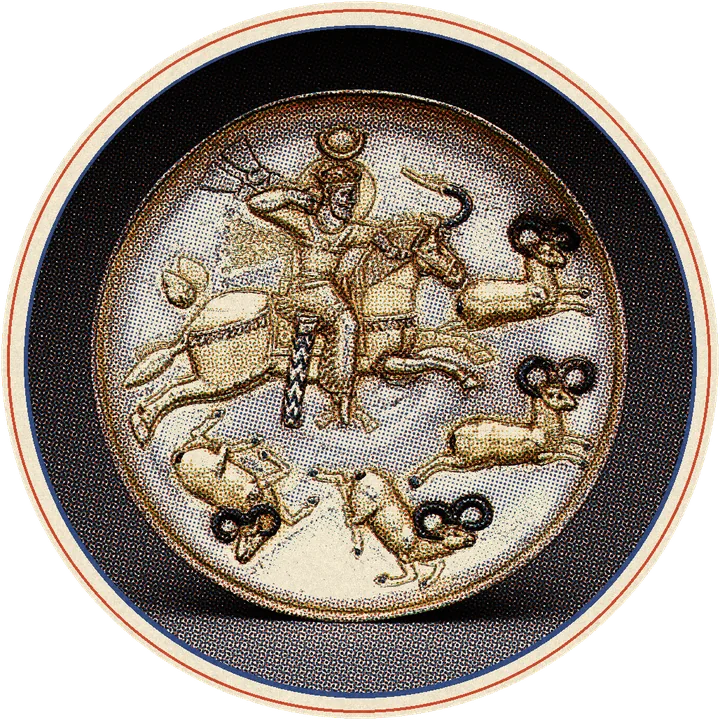
The Sasanians left no mosaics like those of Ravenna, but they did leave huge reliefs carved into the cliffs of Persia and silver plate given as gifts to kings and ambassadors. In the reliefs at Naqsh-e Rostam, Shapur I appears on horseback while a Roman emperor kneels before him: Valerian, captured in 260, seventy years before Constantinople was founded. On the plates, the king hunts lions, rams or deer: the hunt was how the king showed that he protected the order of the world.
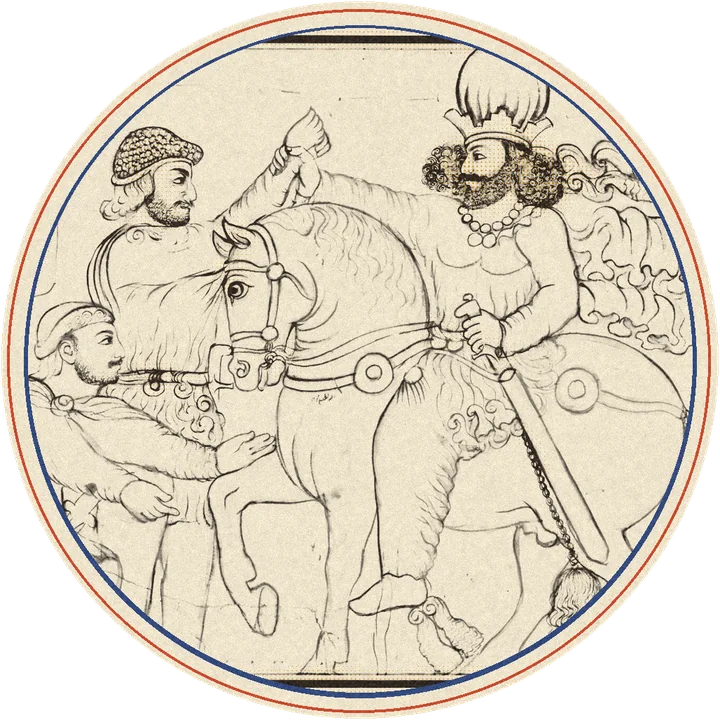
The last war
On the pretext of avenging Maurice, Khosrow II launched the greatest Persian offensive in history. The war lasted twenty-six years and came close to wiping Byzantium off the map.
Jerusalem and Egypt
The Persians took Antioch and Damascus. In 614 they entered Jerusalem and carried the relic of the True Cross off to Ctesiphon. Then Egypt fell, the granary of Constantinople.
Constantinople besieged
A Persian army camped at Chalcedon, across the Bosphorus, while the Avars and their Slav allies besieged the capital by land. The walls of Theodosius held, and the fleet kept the two armies from joining up.
Heraclius strikes at the heart of Persia
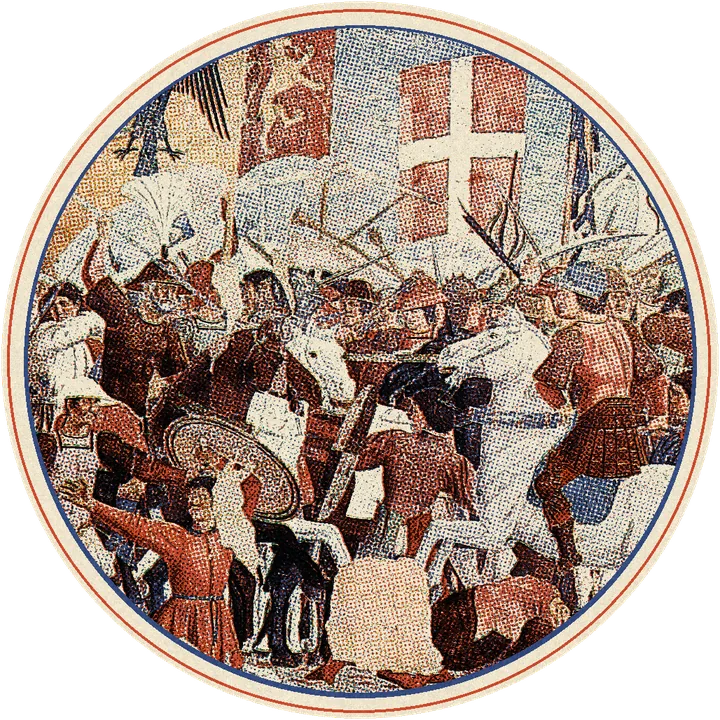
Emperor Heraclius did the unthinkable: instead of defending himself, he attacked. He came down from the Caucasus into Mesopotamia and in December 627 won at Nineveh. Khosrow II was overthrown by his own nobles, and Persia gave back everything it had taken, True Cross included.
A new power
Both empires were exhausted. Out of Arabia came the armies of the new Islamic state. In 636 they defeated the Byzantines at the Yarmuk and the Persians at Qadisiyya; soon afterwards Ctesiphon fell.
The end of the Sasanians
The last king of kings, Yazdegerd III, fled east and was murdered near Merv in 651. All of Persia passed to the caliphate. Byzantium survived, but without Syria, Palestine or Egypt.
The winner no one expected
Heraclius celebrated his triumph by returning the True Cross to Jerusalem in 630. Just six years later his armies lost that same city, for ever, to an enemy that neither Romans nor Persians had taken seriously. Byzantium fell back on Anatolia, the Balkans and the sea, and became the Greek empire that would last until 1453.
An empire that changed so as not to fall
Between 395 and 651 the Eastern Roman Empire lost half its provinces and almost all its conquests in the West. But it kept what mattered: an impregnable capital, a state able to collect taxes and pay armies, a Church and a body of law. It stopped being Latin and became Greek; it stopped looking towards Rome and began looking east.
Persia, by contrast, disappeared as a state. But its culture, its administration and its language passed into the Islamic world, which inherited them and multiplied them. The struggle between the two giants opened the door to a third.
Two empires wore each other out. A third, that no one expected, inherited the world.
The key dates
Tap a date to see what happened.
Twelve words to understand Byzantium and Persia
Tap each word to find out what it means.
How much do you remember?
Five questions on what you have just read.